
If human beings made decisions purely based on rationality, we would probably buy far fewer things than we do today.
Yet everyday life tells a different story. Smartphones are replaced long before they stop working. Closets are filled with clothes that are rarely worn. Vehicles are traded in despite being perfectly functional. Subscription services remain active even when barely used.
Why does this happen?
The answer lies at the intersection of psychology, behavioral economics, sociology, and marketing.
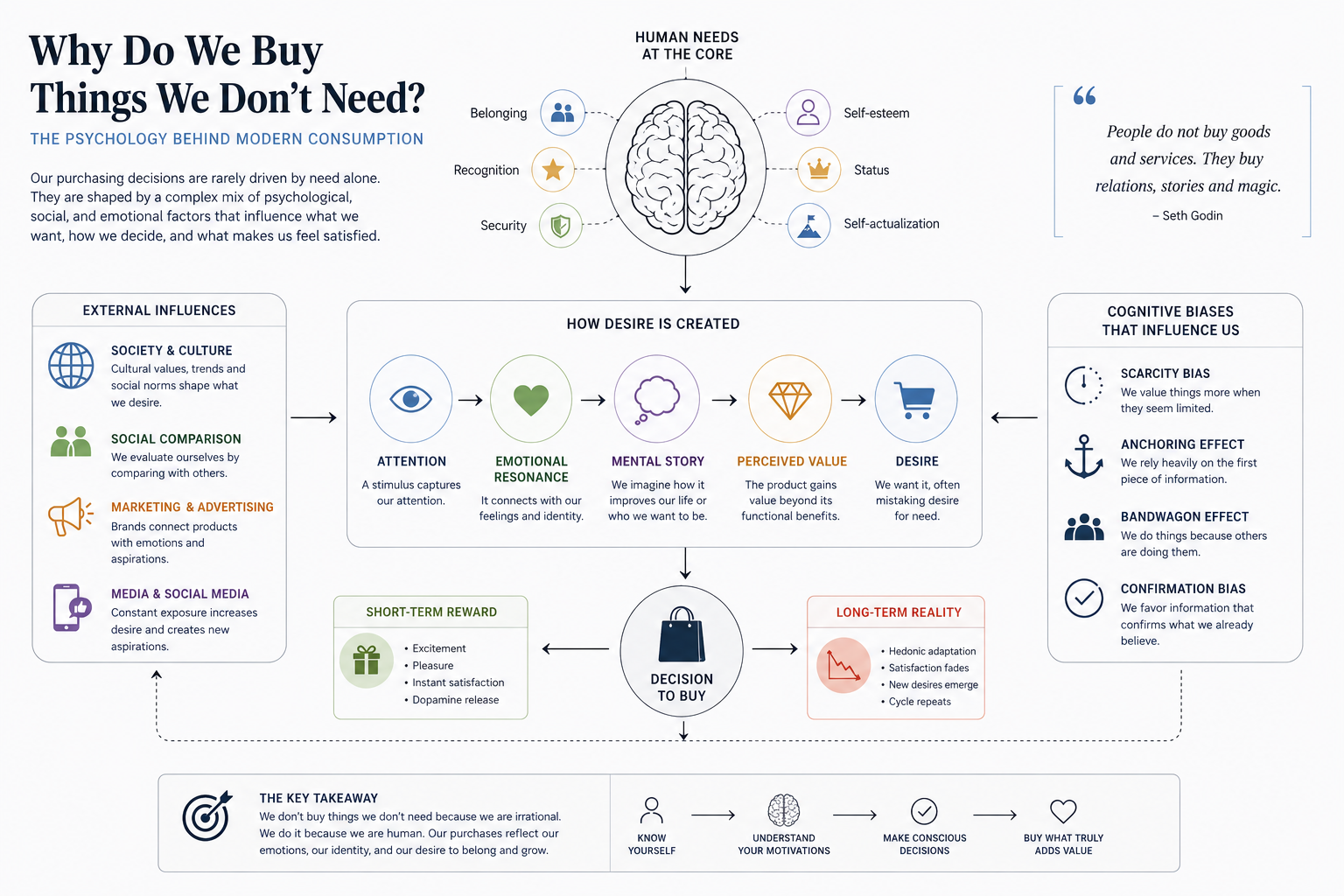
Contrary to traditional economic assumptions, consumers are not perfectly rational decision-makers who objectively evaluate every purchase. Instead, our choices are influenced by emotions, cognitive biases, social pressures, aspirations, and deeply rooted evolutionary mechanisms.
Understanding why we buy things we do not need provides valuable insights not only into consumer behavior but also into human nature itself.
The Myth of the Rational Consumer
For much of the twentieth century, economic theory was built around the concept of Homo Economicus — a rational individual who consistently makes decisions that maximize benefits while minimizing costs.
However, decades of research have challenged this assumption.
Psychologist and economist Daniel Kahneman demonstrated that people frequently rely on mental shortcuts known as heuristics, which simplify decision-making but often lead to systematic biases and irrational behavior.
As Kahneman famously noted:
"Much of what we think we know about our own thinking is wrong."
Rather than carefully analyzing every option, consumers often make intuitive decisions and later use logic to justify them.
In many cases, emotion leads and reason follows.
We Don't Buy Products; We Buy Meaning
One of the most important principles in modern marketing is that consumers rarely purchase products solely for their functional utility.
A watch does more than tell time.
A car does more than provide transportation.
A luxury handbag does more than carry personal belongings.
Products often serve as symbols that communicate messages about identity, status, values, and aspirations.
The economist and sociologist Thorstein Veblen introduced the concept of conspicuous consumption, describing how individuals purchase goods not only for their utility but also for the social prestige they convey.
More than a century later, the principle remains remarkably relevant.
Consumers frequently purchase products because they represent:
- Success
- Achievement
- Exclusivity
- Sophistication
- Wealth
- Social recognition
- Personal identity
In this sense, products become vehicles for meaning.
The Human Need for Belonging
Humans are inherently social creatures.
Throughout evolutionary history, belonging to a group increased the likelihood of survival. Social exclusion often carried significant risks.
Although modern society is vastly different, our psychological need for belonging remains deeply embedded.
Psychologist Abraham Maslow identified belongingness as one of the fundamental human motivations within his Hierarchy of Needs.
Many purchasing decisions are influenced by this desire to be accepted, recognized, and included.
Brands often create communities around their products because they understand this principle.
Consumers are not simply buying an object.
They are buying access to a group, a culture, or an identity.
Social Comparison and Consumer Desire
In 1954, psychologist Leon Festinger proposed the Social Comparison Theory, arguing that individuals evaluate themselves by comparing their abilities, achievements, and possessions to those of others.
This mechanism remains highly influential today.
In the age of social media, people are constantly exposed to:
- Luxury lifestyles
- Expensive vacations
- New vehicles
- Fashion trends
- Career achievements
- Personal milestones
As a result, consumer desires are often shaped not by necessity but by comparison.
People rarely evaluate what they have in absolute terms.
Instead, they evaluate what they have relative to others.
This process can generate aspirations that translate into purchasing behavior.
Dopamine and the Anticipation of Reward
One of the most misunderstood concepts in popular psychology is dopamine.
Contrary to common belief, dopamine is not simply the "pleasure chemical."
Research suggests that dopamine plays a significant role in motivation, anticipation, and reward-seeking behavior.
In many cases, consumers derive more excitement from anticipating a purchase than from owning the product itself.
This explains why activities such as:
- Researching products
- Comparing alternatives
- Waiting for delivery
- Unboxing purchases
can feel surprisingly rewarding.
However, this satisfaction is often temporary.
Psychologists refer to this phenomenon as hedonic adaptation.
What initially feels exciting eventually becomes normal.
As a result, consumers often seek new purchases to recreate the same emotional experience.
The Psychology of Scarcity
Scarcity is one of the most powerful principles in advertising and persuasion.
Research by Robert Cialdini identified scarcity as a key factor influencing human decision-making.
When something appears limited or difficult to obtain, its perceived value tends to increase.
This is why marketers frequently use messages such as:
- Limited edition
- Only a few left
- While supplies last
- Exclusive offer
These messages activate a psychological response commonly known as Fear of Missing Out (FOMO).
Consumers become concerned about losing access to an opportunity, making them more likely to purchase.
We Often Buy Future Versions of Ourselves
Perhaps one of the most fascinating aspects of consumer behavior is that people often purchase products not for who they are today, but for who they hope to become.
Consumers buy:
- Books they intend to read
- Fitness equipment they plan to use
- Online courses they hope to complete
- Professional tools they aspire to master
In many cases, the purchase represents an investment in an imagined future self.
The product becomes a symbol of personal growth, transformation, or ambition.
Consumers are not merely buying an object.
They are buying a possibility.
Does Advertising Create Needs?
Advertising is often criticized for creating artificial needs.
However, from an academic perspective, advertising rarely creates entirely new human motivations.
Instead, it connects products to desires that already exist.
These desires may include:
- Security
- Status
- Recognition
- Love
- Achievement
- Social acceptance
- Self-improvement
Effective advertising succeeds because it aligns products with psychological needs that consumers already possess.
Rather than creating desire, advertising amplifies and directs it.
The Paradox of Modern Consumption
Modern societies enjoy unprecedented levels of material abundance.
Yet increased consumption does not always lead to increased satisfaction.
Many purchases provide temporary happiness, but that feeling often fades over time.
This does not mean consumption is inherently negative.
Products can improve comfort, convenience, productivity, and quality of life.
However, material possessions alone rarely fulfill deeper psychological needs.
Meaningful relationships, personal growth, purpose, and belonging continue to play a far greater role in long-term well-being.
Conclusion
The next time you feel the urge to buy something, consider asking a different question.
Instead of asking:
"Do I need this?"
Ask:
"What does this represent to me?"
The answer may reveal motivations that extend far beyond the product itself.
Because most consumer purchases are not simply economic transactions.
They are expressions of identity.
They are attempts to belong.
They are symbols of aspiration.
They are reflections of who we are—and who we hope to become.
Understanding these mechanisms not only makes us better marketers.
It also makes us more aware consumers.


0 comments
No published comments yet
Be the first to leave an opinion and rating on this article.